For information about upcoming SBI events or to schedule SBI courses for your agency, please email Melanie Torres at melanie.torres@edcda.us
Explore all SBI resources and publications in the SBI Research Explorer — search by topic or author, browse by SBI concept, and build your own reading list –> Launch the Research Explorer
Note: Access to the SBI Research Explorer is limited to training participants. Use the access code provided at your training or by our office.
SBI Symposium Presentation Links:
Download the PDF below and click on the session to access presentation materials:
Day 1 Presentations:
Day 2 Presentations:
Empathy and Evocation in Investigative Interviewing
The Fontana PD Case and The Yogurt Shop Murders
Decision Inertia and Complex Environments
Decision-Making: Inside and Outside the Interview Room
AI Data Management Systems: Helping Carry the Cognitive Load
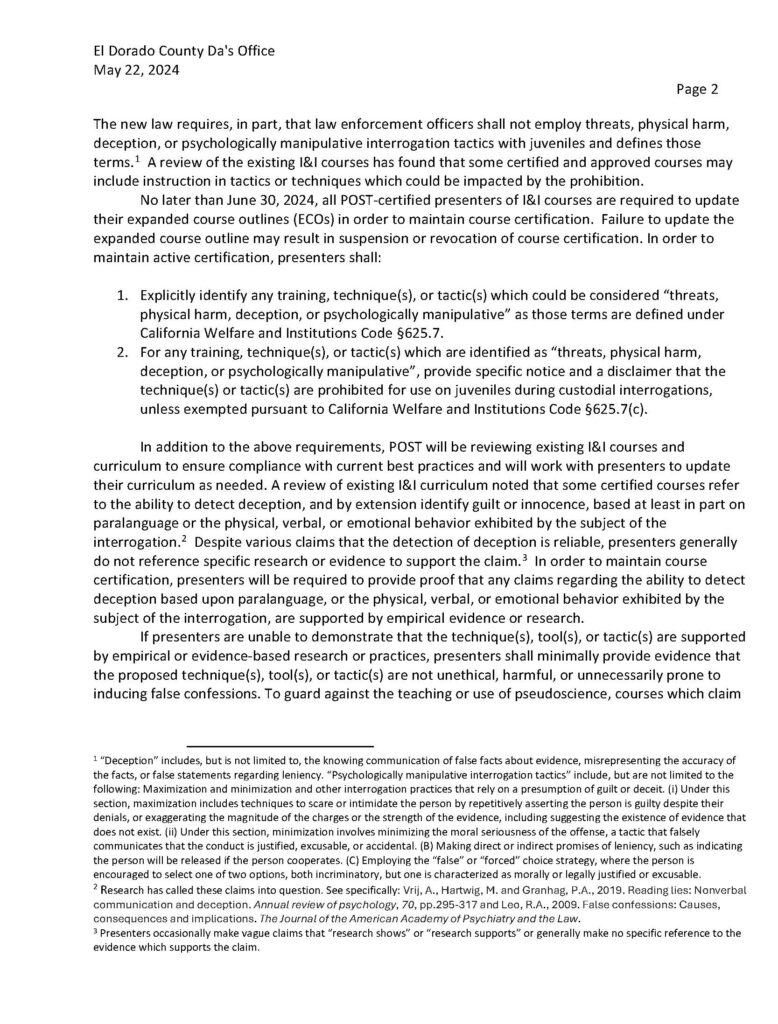
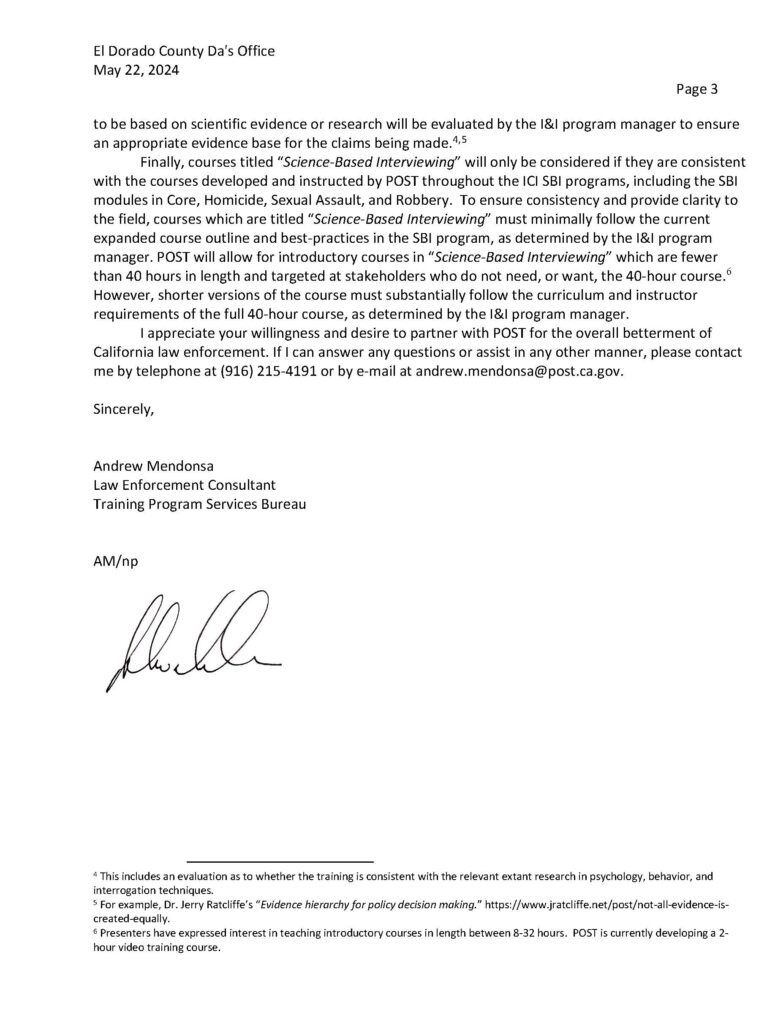
SBI TRAINING NATIONWIDE
SBI INTERVIEW PREPARATION
SBI CASE PREPARATION
MODEL CRIME CHARGING POLICY
THE STRATEGIC USE OF EVIDENCE VIDEOS
Video: The Ruse
Special Feature: 48 Hours – The Last Word – Visit our Dropbox folder to view
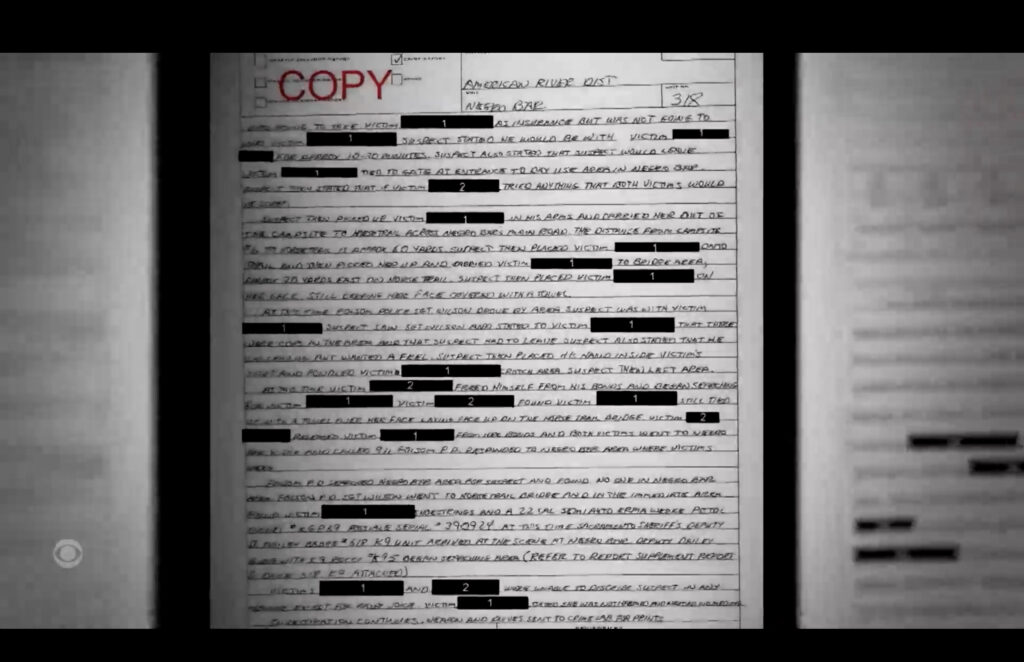

HIG Publication List:
SBI WORKBOOK REFERENCE LINKS:
THE ROLE OF RAPPORT IN INTERVIEW
Abbe, A., & Brandon, S. E. (2013). The role of rapport in investigative interviewing: A review. Journal of investigative psychology and offender profiling, 10(3), 237-249.
Abbe, A., & Brandon, S. E. (2014). Building and maintaining rapport in investigative interviews. Police practice and research, 15(3), 207-220.
https://www.penguin.co.uk/books/438570/rapport-by-emily-alison/9781785042065 Alison, Emily. Rapport: The Four Ways to Read People. Penguin Random House, 2021.
https://academic.oup.com/book/31822/chapter-abstract/266771238? Alison, Laurence & Barrett-Pink, Chloe & Surmon-Böhr, Frances & Shortland, Neil & Alison, Emily & Christiansen, Paul. (2020). How to Build Rapport: Assessing the Effectiveness of ORBIT Training with Police Interviewers. 10.1093/med-psych/9780197545959.003.0008.
Alison, L. J., Alison, E., Noone, G., Elntib, S., & Christiansen, P. (2013). Why Tough Tactics Fail And Rapport Gets Results: Observing Rapport-Based Interpersonal Techniques (ORBIT) To Generate Useful Information From Terrorists. Psychology, Public Policy, and Law, 19(4), 411.
Brimbal L, Meissner CA, Kleinman SM, Phillips EL, Atkinson DJ, Dianiska RE, Rothweiler JN, Oleszkiewicz S, Jones MS. Evaluating the benefits of a rapport-based approach to investigative interviews: A training study with law enforcement investigators. Law Hum Behav. 2021 Feb;45(1):55-67. doi:10.1037/lhb0000437. PMID: 33734749.
https://psycnet.apa.org/record/2022-83099-001 Dion Larivière, C., Crough, Q. & Eastwood, J. (2022). The effects of rapport building on information disclosure in virtual interviews. Journal of Police and Criminal Psychology, 38, 452-460.
https://osf.io/preprints/psyarxiv/d3w28_v1 Gabbert, F., Hope, L., Luther, K., Wright, G., Ng, M., & Oxburgh, G. (2020). Pre-print, Exploring the use of rapport in professional information‐gathering contexts by systematically mapping the evidence base. Applied Cognitive Psychology.
https://psycnet.apa.org/fulltext/2020-01274-001.html Kim, S., Alison, L., & Christiansen, P. (2020, January 16). Observing Rapport-Based Interpersonal Techniques to Gather Information From Victims. Psychology, Public Policy, and Law. Advance online publication.
https://pubmed.ncbi.nlm.nih.gov/34955997/ Giles S, Alison L, Christiansen P, Humann M, Alison E, Tejeiro R. An Economic Evaluation of the Impact of Using Rapport-Based Interviewing Approaches With Child Sexual Abuse Suspects. Front Psychol. 2021 Dec 9;12:778970. doi: 10.3389/fpsyg.2021.778970. PMID: 34955997; PMCID: PMC8696026.
Rosengren, D. B. (2009). Building Motivational Interviewing Skills: A Practitioner Workbook. Guilford Press.
https://livrepository.liverpool.ac.uk/3067114/. Surmon-Böhr, Frances, et al. “The Right to Silence and the Permission to Talk: Motivational Interviewing and High Value Detainees.” The University of Liverpool Repository, American Psychological Association, 1 Oct. 2020.
Vallano, J. P., & Schreiber Compo, N. (2015). Rapport-building with cooperative witnesses and criminal suspects: A theoretical and empirical review. Psychology, Public Policy, and Law, 21(1), 85.
COGNITION AND COGNITIVE INTERVIEW
Cognitive Interview on Suspects – Customs Officers
Nocm M., Ginet, M., & Deslauriers-Varin, N. (2021). The cognitive interview for suspects: A test with customs officers. J Investig Psychol Offender Profile. 19: 167-184.
https://www.simplypsychology.org/cognitive-interview.html McLeod, S. (2023). Cognitive Interview Technique.
https://www.tandfonline.com/doi/full/10.1080/1068316X.2017.1351966 Paulo, R., Albuquerque, P., et al. (2017). Enhancing the Cognitive Interview with an Alternative Procedure to Witness-Compatible Questioning: Category Clustering Recall. Psychology, Crime and Law, 23(10): 1-10. DOI:10.1080/1068316X.2017.1351966
www.forcescience.com/2024/08/maximizing-the-involved-officers-recollections-before-the-big-interview/. Geiselman, R. Edward. “Maximizing the Involved Officer’s Recollections before ‘The Big Interview’ – Force Science.” Force Science – Research | Training | Consulting, 7 Aug. 2024.
Memon, A., Meissner, C. A., & Fraser, J. (2010). The Cognitive Interview: A meta-analytic review and study space analysis of the past 25 years. Psychology, Public Policy, and Law, 16(4), 340.
Sneyd, D., & Fisher, R. P. (2024). Cognitive interview conducted in-person and over-the-phone for informants’ memory of overheard conversations. Journal of Investigative Psychology and Offender Profiling, e1638. Winter 2025 / Vol. 01
Vrij, A., Mann, S. A., Fisher, R. P., Leal, S., Milne, R., & Bull, R. (2008). Increasing cognitive load to facilitate lie detection: The benefit of recalling an event in reverse order. Law and Human Behavior, 32, 253-265.
https://www.tandfonline.com/doi/full/10.1080/1068316X.2019.1652748 Kimberley A. McClure, Katherine L. McGuire & Elizabeth F. Loftus (2020) Officers’ memory and stress in virtual lethal force scenarios: Implications for policy and training, Psychology, Crime & Law, 26:3, 248-266, DOI: 10.1080/1068316X.2019.1652748
Vrij A and Fisher RP (2020) Unraveling the Misconception About Deception and Nervous Behavior. Front. Psychol. 11:1377. doi: 10.3389/fpsyg.2020.01377
Vrij, A., Granhag, P. A., Mann, S., & Leal, S. (2011). Outsmarting the liars: toward a cognitive lie detection approach. Current Directions in Psychological Science, 20(1), 28-32.
SCIENCE BASED SUSPECT INTERVIEWING
https://www.ialeia.org/docs/Psychology_of_Intelligence_Analysis.pdf Heuer, Richards J. (1999). Psychology of Intelligence Analysis. Center for the Study of Intelligence, Central Intelligence Agency.
Meissner, C. A., Surmon-Böhr, F., Oleszkiewicz, S., & Alison, L. J. (2017). Developing an evidence-based perspective on interrogation: A review of the US government’s high-value detainee interrogation group research program. Psychology, Public Policy, and Law, 23(4), 438.
Russano, Melissa & Kelly, Christopher & Meissner, Christian. (2019). From the ivory tower to the interrogation room: Training and field evaluation research on suspect interviewing.
Vrij, A., Meissner, C. A., Fisher, R. P., Kassin, S. M., Morgan III, C. A., & Kleinman, S. M. (2017). Psychological perspectives on interrogation. Perspectives on Psychological Science, 12(6), 927-955.
Vrij, A., Hope, L., & Fisher, R. P. (2014). Eliciting reliable information in investigative interviews. Policy Insights from the Behavioral and Brain Sciences, 1(1), 129-136.
US Government. (2009). A Tradecraft Primer: Structured Analytic Techniques for Improving Intelligence Analysis.
https://osf.io/gpqre/?view_only=84e231948328479bbd9fc94ec15e615b Ferreira, P. A., Curran, B., & Meissner, C. A.(n.d.). The Miranda waiver literature: A systematic review and meta-analysis. Iowa State University, Department of Psychology.
SCIENCE BASED INTERVIEWING AND ITS ROLE IN AVOIDING FALSE CONFESSIONS
https://www.frontiersin.org/articles/10.3389/fpsyg.2016.00243/full. Bogaard, Glynis, et al. “Scientific Content Analysis (SCAN) Cannot Distinguish between Truthful and Fabricated Accounts of a Negative Event.” Frontiers, Frontiers, 5 Feb. 2016.
https://doi.org/10.1002/jip.1532 Jordan S, Brimbal L, Wallace DB, Kassin SM, Hartwig M, Street CNH. A test of the micro-expressions training tool: Does it improve lie detection? J Investig Psychol Offender Profil. 2019;1–14.
Gudjonsson GH (2021) The Science-Based Pathways to Understanding False Confessions and Wrongful Convictions. Front. Psychol. 12:633936. doi: 10.3389/fpsyg.2021.633936
Kassin SM (2017) False Confessions: How Can Psychology So Basic Be So Counterintuitive. American Psychologist. Vol 72, No.9, 951-964
https://www.researchgate.net/publication/388853571_Policeinduced_confessions_20_Risk_factors_and_recommendations Kassin SM, Drizin SA, Grisso T, Gudjonsson GH, Leo RA, Redlich AD. (2010). Police-induced Confessions, 2.0. Risk Factors and Recommendations Law Hum Behav. 2025 Feb;49(1): 7-53. doi: 10.1037/lhb0000593.
https://www.researchgate.net/publication/333665198_Lessons_From_Pinocchio_Cues_to_Deception_May_Be_Highly_Exaggerated Luke TJ. Lessons From Pinocchio: Cues to Deception May Be Highly Exaggerated. Perspect Psychol Sci. 2019 Jul;14(4):646-671. doi: 10.1177/1745691619838258. Epub 2019 Jun 7. PMID: 31173537. (PDF)
https://www.law.umich.edu/special/exoneration/Pages/casedetail.aspx?caseid=5592. Otterbourg, K. (2024). Christopher Tap. National Registry of Exonerations.
https://www.law.umich.edu/special/exoneration/Pages/casedetail.aspx?caseid=3845. Warden, R. (2019). Terrill Swift. National Registry of Exonerations.
https://psycnet.apa.org/record/2025-10649-001?doi=1 Brimbal, L., Roche, S., Martaindale, M. (2024). Interviewing and interrogation practices and beliefs, 20 years later: A national self-report survey of American police. Law and Human Behavior, 48(4), 247-261. DOI: 10.1037/lhb0000570. Interviewing and interrogation practices and beliefs, 20 years later: A national self-report survey of American police.
THE EFFECT OF COGNITIVE BIAS ON LAW ENFORCEMENT
https://www.google.com/books/edition/_/h7EH0QEACAAJ?hl=en Brandon, Susan E., and Simon Wells. Science-Based Interviewing. BookBaby, 2019.
Charman, S. D., Kavetski, M., & Mueller, D. H. (2017). Cognitive bias in the legal system: Police officers evaluate ambiguous evidence in a belief-consistent manner. Journal of Applied Research in Memory and Cognition, 6(2), 193-202.
SCIENCE BASED INTERVIEWING
https://www.tandfonline.com/doi/full/10.1080/1068316X.2022.2043312? Amy Hyman Gregory, Andrea Wolfs & Nadja Schreiber Compo (2022) Witness/victim interviewing: a survey of real-world investigators’ training and practices, Psychology, Crime & Law, DOI:10.1080/1068316X.2022.2043312
https://doi.org/10.1037/lhb0000570 Brimbal, L., Roche, S. P., & Martaindale, M. H. (2024). Interviewing and interrogation practices and beliefs, 20 years later: A national self-report survey of American police. Law and Human Behavior, 48(4), 247–261.
https://www.researchgate.net/profile/Christian-Meissner- 2/publication/277596311_Interrogation_and_Investigative_Interviewing_in_the_United_States_Research_ and_Practice/links/556e061f08aeab7772269f9f/Interrogation-and-Investigative-Interviewing-in-the- United-States-Research-and-Practice.pdf Kelly, C. & Meissner, C. (2015). Interrogation and Investigative Interviewing in the United States: Research and Practice.
O’Neill, Desmond S. “From third-degree to third-generation interrogation strategies: putting science into the art of criminal interviewing.” NAVAL POSTGRADUATE SCHOOL, 2017.
https://wordpress-dev.auburn.edu/mccrary/work/the-art-of-the-inquiry-the-lapds-journey-with-science-based-interview-techniques/ Sutliff, Usha, and Mark Severino. The Art of the Inquiry: The LAPD’s Journey with Science-Based Interview Techniques. Center for Cyber and Homeland Security at Auburn University, 2022.
https://www.fis-international.com/assets/Uploads/resources/Schollum-PEACE.pdf. Schollum, M. (2017, November). Bringing PEACE to the United States: A framework for investigative interviewing. The Police Chief, 84(11), 34-35. Forensic Interview Solutions.
https://doi.org/10.1080/24732850.2025.2610830 Denault, V. et al. (2026) ‘Pseudoscientific Practices in Fraud Investigations: A Case Study’, Journal of Forensic Psychology Research and Practice, pp. 1–18. doi: 10.1080/24732850.2025.2610830.
STRATEGIC USE OF EVIDENCE
https://doi.org/10.1002/9781118510001.ch10. Granhag, Pär Anders, and Maria Hartwig. “The Strategic Use of Evidence Technique.” Detecting Deception, 2014, pp. 231–251.
https://onlinelibrary.wiley.com/doi/full/10.1002/acp.3767 Oleszkiewicz, S., & Watson, S. J. (2021). A meta‐analytic review of the timing for disclosing evidence when interviewing suspects. Applied Cognitive Psychology, 35(2), 342-359. A meta‐analytic review of the timing for disclosing evidence when interviewing suspects – Oleszkiewicz – 2021 – Applied Cognitive Psychology – Wiley Online Library
DECEPTION DETECTION
https://scholar.google.com/citations?view_op=view_citation&hl=en&user=NgCkhIsAAAAJ&cstart=20&pagesize=80&citation_for_view=NgCkhIsAAAAJ%3AUxriW0iASnsC Jordan, S., Brimbal, L., et al. (2019). A test of the micro-expressions training tool: Does it improve lie detection? Journal of Investigative Psychology and Offender Profiling, 16(3), 222-235. A test of the micro-expressions training tool: Does it improve lie detection?
https://www.annualreviews.org/content/journals/10.1146/annurev-psych-010418-103135. Vrij, Aldert, et al. “Reading Lies: Nonverbal Communication and Deception.” Annual Review of Psychology, vol. 70, no. 1, 2019, pp. 295–317.
https://www.researchgate.net/publication/389710447_Lie_detection_trainings_and_fallacies Denault, V. (2025). Lie detection trainings and fallacies. Project Aletheia (John Jay College of Criminal Justice, CUNY).
New:
https://www.eldoradoda.com/wp-content/uploads/2026/04/Crisis-Negotiation-Article.pdf The Aspirin of Crisis Negotiation: Judging the Use of Active Listening Skills (ALS) by Negotiators by Sergeant Duwayne A. Poorboy, Marcos, Texas Police Department, Elizabeth A. Quinby, M.A., LPCC, Texas State University, The Aspirin of Crisis Negotiation: Judging the Use of Active Listening Skills (ALS) by Negotiators.
https://www.eldoradoda.com/wp-content/uploads/2026/04/Patrol-Training-Communications-Article.pdf Improving Communication Skills in Patrol Officers: A Training Study of Evidence-based Interviewing by Laure Brimbal, Ph.D., Texas State University | Mark Severino, Los Angeles Police Department (Ret.), Angela M. Jones, Ph.D., Texas State University | D. Kim Rossmo, Ph.D., Texas State University, Enhancing Police Research Partnerships: A Path to Actionable Findings and Community Trust.
https://www.eldoradoda.com/wp-content/uploads/2026/04/Denault-et-al_2026_accepted_manuscript.pdf Pseudoscientific Practices in Fraud Investigations: A Case Study by Vincent Denault, School of Criminology, University of Montreal, Kirk Luther, Department of Psychology, Carleton University, Joseph Eastwood, Faculty of Social Science and Humanities, Ontario Tech University, Cassandre Dion Larivière, Faculty of Social Science and Humanities, Ontario Tech University, Victoria Talwar, Department of Educational and Counselling Psychology, McGill University, Sébastien Béland, Department of Administration and Foundations of Education, University of Montreal